Understand AI
Students learn how AI works, where it creates opportunities and where critical questioning is essential.
UNDERSTAND AI · THINK INDEPENDENTLY · LEARN WITH PEOPLE
In small online learning groups, students develop the skills to use artificial intelligence competently, question its output and make well-founded decisions of their own. German and English are taught as distinct subjects of equal value.
Explore our learning model ↓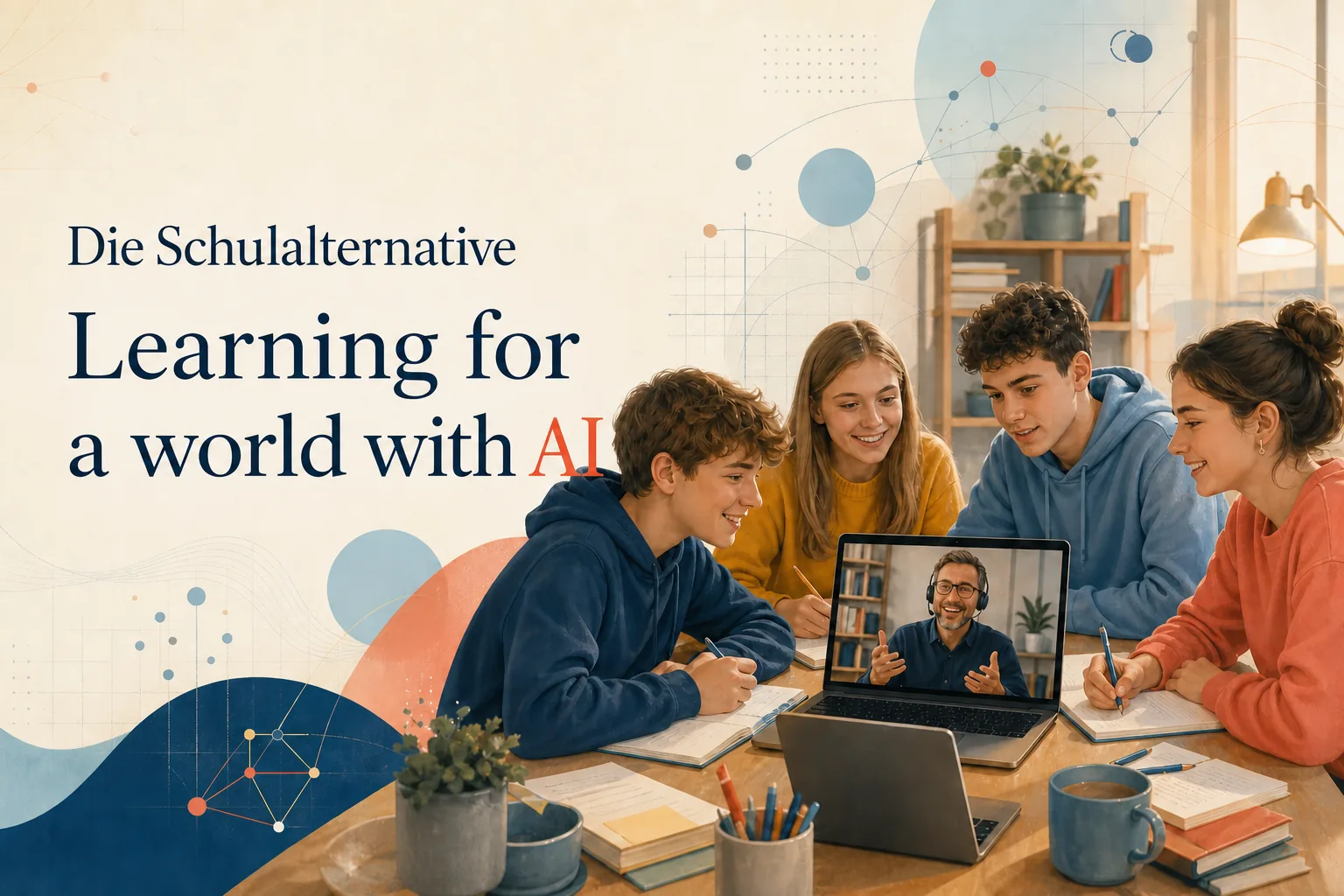
Our approach
“Independent thought provides direction. AI becomes a tool—the human remains the creator.”
EDUCATION WITH FORESIGHT
Our online school combines strong subject foundations with AI literacy, source criticism, creativity and personal guidance. Students learn to use modern tools without handing their judgement over to them.
Students learn how AI works, where it creates opportunities and where critical questioning is essential.
The machine does not decide: we strengthen judgement, creativity, source criticism and responsible action.
Dedicated teachers, small groups and direct dialogue provide guidance, connection and personal feedback.
Both languages have equal standing as distinct subjects. In mathematics and general education, the second language is introduced gradually and with care.
THE LEARNING MODEL
10–18years of age
5–12grade levels, broadly comparable to Gymnasium
12live lessons per week
Live classes in small groups, dedicated subject teachers and a clear weekly rhythm from 1 p.m. Central European Time create consistency. Each 45-minute lesson can be planned reliably by families in Germany and around the world.
SCHOOL LEADERSHIP
Lina Kühn is a trained education professional and holds the German title Studienrätin. Our subject teachers come from professional industry backgrounds and combine subject-specific expertise with strong AI expertise.
As a trained education professional and Studienrätin, she ensures that teaching methods, communication and expectations reflect students' ages, development and individual capabilities.
Responsible for the commercial and organisational foundation of a reliable school experience.
OUR SUBJECTS
Logic, problem-solving and the ability to assess results thoughtfully.
Using English actively through speaking, understanding and writing.
Developing confident expression through speaking, reading and writing in German.
Understanding society, nature and technology in context.
EXPLORE OUR TOPICS
QUESTIONS & ANSWERS
Detailed answers about our online classes, critical engagement with artificial intelligence and personal support.
No. Real people shape every lesson. Our teachers guide students personally, explain connections, answer questions and respond to individual needs. Artificial intelligence is an important subject and can be used as a tool, but it does not replace teachers or personal interaction. Our aim is warm, interactive online education in which young people are seen, respected and reliably supported.
Classes are interactive and take place live with teachers. Students can ask questions, contribute their thoughts, discuss ideas and receive direct feedback. This is not an automated program where children only watch videos or complete tasks alone. We combine digital possibilities with personal guidance, human interaction and a reliable learning structure.
AI is already changing learning, work, communication and everyday decisions. Young people will regularly encounter AI systems throughout their lives. Knowing how to operate a tool is therefore not enough. Students should understand how these systems work, what opportunities they offer and where their limits and risks lie. They learn to use AI independently and responsibly without surrendering their own thinking.
Students learn to question AI answers, detect errors and fabricated information, compare sources, verify claims, recognise bias and one-sided representations, protect personal data, develop their own arguments and solutions, and take responsibility for their decisions and work. AI is treated as a useful tool—not an infallible authority.
Yes. Human connection is central to our approach. Learning works particularly well when young people feel safe, respected and personally addressed. Teachers can encourage, listen, notice uncertainty, accompany conflicts and show genuine interest. Software cannot replace these human qualities, which is why we combine future-ready education with a warm, respectful and personal learning environment.
Alongside the responsible use of AI, we focus on essential, practical foundations in mathematics, German, English, general education and science. The aim is not to memorise the greatest possible amount of material. Students learn to read, write, communicate, argue, understand connections and assess information—skills that also help them judge the plausibility and accuracy of AI output.
No. Content is deliberately concentrated on what matters. The key question is not how many isolated facts a student can memorise briefly, but whether they understand connections and can apply knowledge in real life. We combine solid foundations, independent thought and practical capability so students can assess new situations and develop suitable solutions.
Our approach is not based on passive or isolated media consumption. Online education should enable exchange, participation and shared thought. Depending on the topic, learning also happens away from the screen through reading, writing, observation, experiments, research and practical experiences. The computer provides access to lessons, but it is not the entire learning environment.
Young people learn in different ways. Personal feedback, understandable explanations and opportunities to ask questions are therefore essential. Teachers observe progress, notice difficulties early and provide orientation. Students do not pass anonymously through a program; they are seen and supported as individual people.
Our offer is designed for families seeking contemporary, location-independent and personally guided learning. It may be especially relevant to families in Germany or abroad, travelling families, self-directed learners and parents looking for an alternative to overloaded curricula. Future-ready education, essential knowledge, independent thinking and responsible use of AI are at the heart of the school.
German and English are taught as distinct language subjects. German classes are conducted in German, and English classes in English. In mathematics and general education, the bilingual element grows carefully with each learning stage: from basic subject vocabulary in Stage 1, through increased use in Stage 2, to extensive use of both languages from Stage 3 onward.
Yes. We want students to be able to use AI as a tool for independent learning beyond the subjects we teach, for example when learning additional foreign languages. They learn to define their own goals, request suitable explanations and exercises, assess the results critically and consult reliable sources. This enables them to explore new subjects with growing independence without handing their thinking or responsibility for the learning process over to AI.
Die Schulalternative is designed for young people aged 10 to 18. The learning groups broadly correspond to German Gymnasium grade levels 5 to 12.
Explore our website or follow Die Schulalternative on Telegram.
DIE SCHULALTERNATIVE
An online school for families in Germany and around the world who consciously choose a different approach to education.
Back to the top ↑